KBB: Brooklyn Botanical
Published in the January/February 2026 issue of Kitchen & Bath Business
With two teenage sons heading off to college, the owners of a Brooklyn brownstone had the foresight to transform the third fl oor into an oasis for the kids that would one day become the empty nesters’ primary suite. Fortunately, planning and tackling such a project was like second nature for owner Hormuz Batliboi, an architect and principal of his own fi rm, Batliboi Studio.
He knew that by removing a space-hogging laundry room, he could expand the floor’s existing tiny bathroom into a more functional jack-and-jill–style bath between the boys’ bedrooms. When their sons move out, one room will become the primary bed- room, while the other will be converted into a walk-in-closet and dressing room. Keeping that future in mind, Batliboi designed the new bath to meet their sons’ daily needs while they’re still at home – but with an aesthetic that he and his wife could enjoy and call a main bathroom.
Going Green
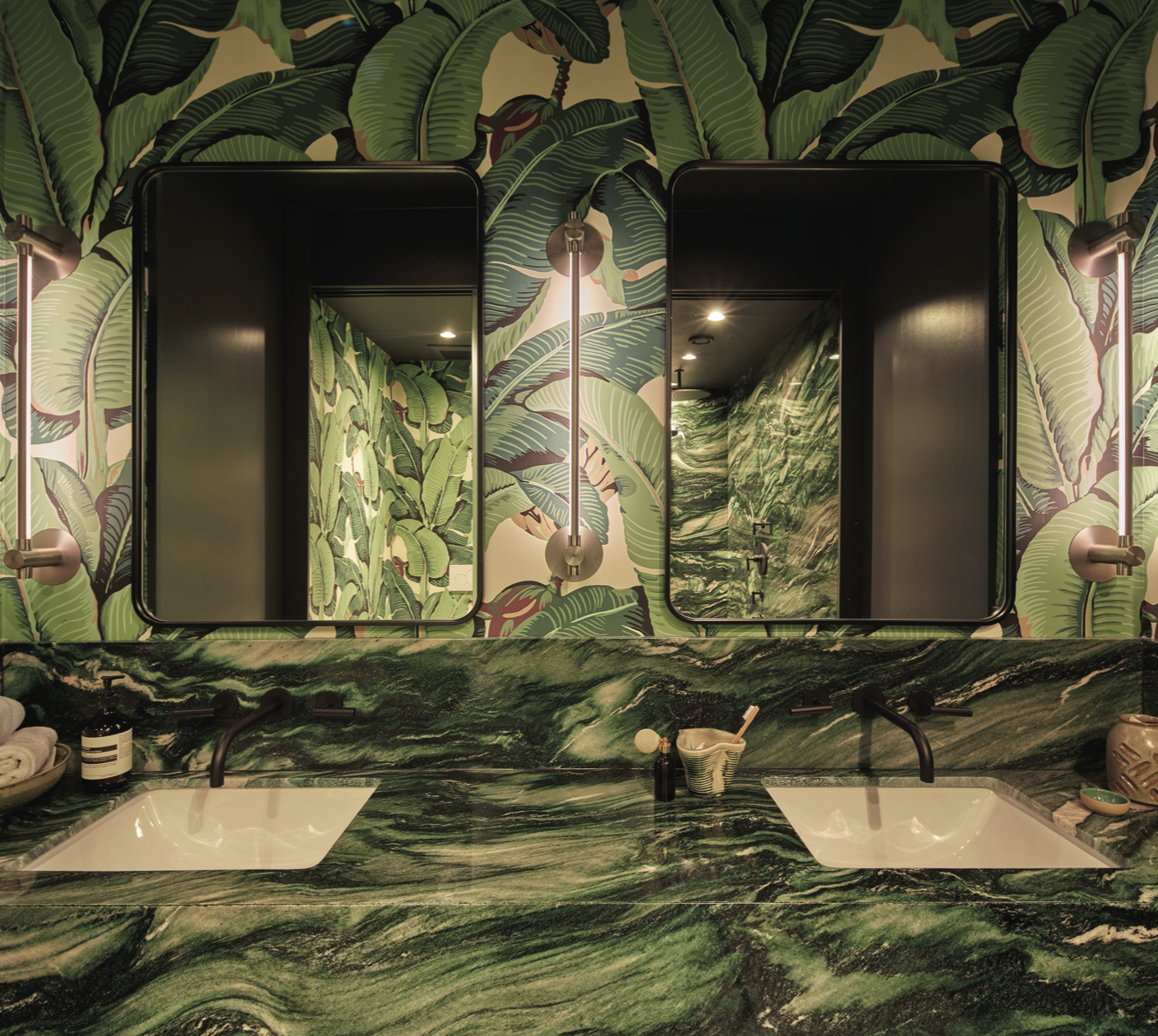
When the homeowners looked at a few different stone options for a custom vanity countertop, they found and fell in love with a striking green-and-black Verde Lapponia granite. “There was just something so expressive about it, like it was painterly,” said the architect, who added that it was clear the stone would become the linchpin around which everything else would be designed.
The dramatic green swirls of the granite indeed led to their choice of wallcovering for the other walls – Scalamandré’s iconic Hinson Palm. The large-scale pattern of tropical leaves not only complements the stone but also recalls the owners’ childhood homes in Mumbai. While both finishes figure prominently at the double vanity, each would come to define the two other zones. The shower walls are entirely clad in the stone, and the toilet side of the bathroom is wallpapered.
To tie everything together and eliminate waste, Batliboi found clever uses for the stone remnants, such as the vanity backsplash, shelving niches carved into the extra-thick walls of the shower and toilet areas, the baseboard in the wallpapered zone and the thresholds at both pocket-door entrances. (The latter extend slightly into the bedrooms, hinting at the lush green-and-black environment beyond the doors.)
In lieu of standard medicine cabinets, Batliboi hollowed out sections in the walls flanking the vanity to form cabinets, then covered both the walls and cabinet doors in the palm wallpaper. Push-to-open hardware reveals this camouflaged and hidden storage, allowing these walls to remain smooth and free of external pulls or knobs.
Toning It Down
To prevent sensory overload, Batliboi specified the rest of the finishes to be complementary but more muted to recede into the background. The custom maple vanity drawers were painted charcoal, as were the pocket doors and ceiling, for instance, while matte black was selected for the plumbing fixtures, hardware and mirror frames. Simple frosted-glass doors stack and slide to provide privacy for the shower and toilet areas, and matte gold – a popular pairing with black – appears in the wall sconces lighting up the vanity. The architect selected penny-round tiles in metallic black and emerald green, then distributed the colors on the floor unevenly to create the illusion of a gradient.
“You have these two colors that were done almost three different ways: the stone, which has its own natural and organic pattern and flow; the floor in this very rigid geometric shape; and then the wallpaper pattern,” said Batliboi. “So the space is like a moment of color packed into a small, condensed experience – and we’re in a time where we all need a little distraction from reality.”